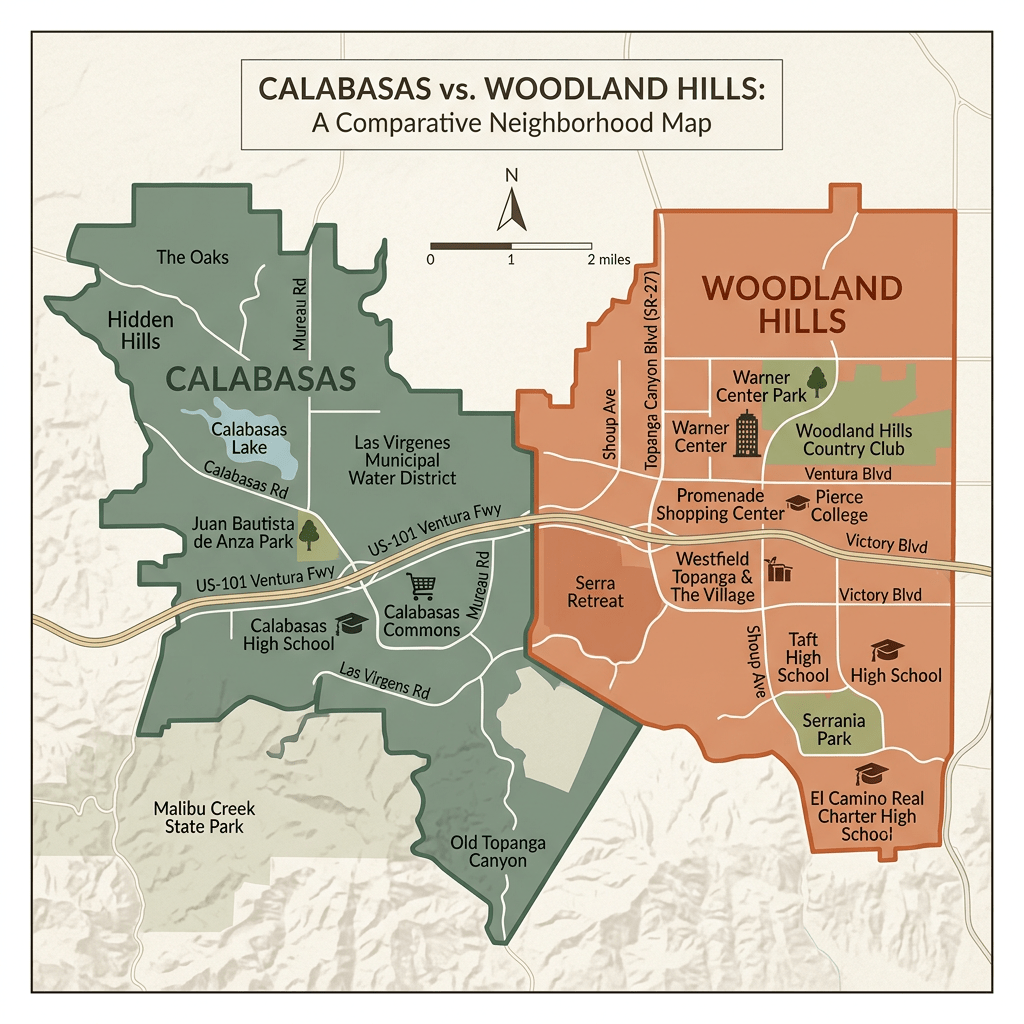
It’s one of the most common conversations I have with buyers moving to the West Valley: “We’re looking at both Woodland Hills and Calabasas — what’s the real difference?”
On a map, they’re neighbors. In practice, they feel like two different worlds — and which one is right for you comes down to your lifestyle, your budget, and honestly, your personality. I’ve sold homes in both areas for years, and here’s the unfiltered version.
The Price Gap Is Real.
Let’s start with the number everyone wants to know.
Woodland Hills** median home price: ~$985,000
Calabasas** median home price: ~$1,700,000 That’s a gap of roughly $700K at the median — though the range in both cities is wide. You can find Woodland Hills homes pushing $2M in the upper hills, and more modest Calabasas townhomes in the $900K range. But broadly speaking, if budget is your primary constraint, Woodland Hills gives you significantly more house for your money.
What does that extra $700K buy you in Calabasas? Primarily: the zip code, the gates, and the schools. Whether those things are worth it is a genuinely personal question.
The Vibe Is Different
Woodland Hills has the feel of a real, lived-in Los Angeles neighborhood. It’s diverse, has a mix of property types, and has genuine urban amenities — the Westfield Topanga mall, a solid restaurant scene on Ventura Boulevard, and neighborhoods that range from modest ranch homes to architecturally significant hillside retreats.
It’s the kind of place where you might live next to a film producer, a school teacher, and a small business owner on the same block. There’s energy and variety here.
Calabasas has a more curated, manicured quality. Many of its most desirable neighborhoods are gated — The Oaks, The Oaks at Calabasas, and others. The streets are immaculate, the landscaping is consistent, and the sense of privacy and security is real. It’s quieter and more homogeneous.
Some buyers love that controlled, resort-like atmosphere. Others find it a bit sterile. Knowing which camp you fall into matters a lot before you buy.
The School Question
Both areas have good schools, but Calabasas has a reputational edge that is reflected in its prices.
Calabasas feeds primarily into the Las Virgenes Unified School District, which consistently ranks among the top districts in Los Angeles County. Calabasas High School is well-regarded, and the elementary and middle schools in the district are strong across the board.
Woodland Hills is served by LAUSD, which is a much larger, more variable district. That said, there are genuinely excellent options within LAUSD if you know where to look. El Camino Real Charter High School is one of the top-performing high schools in the state and draws students from across the West Valley. And at the elementary level, schools like Welby Way and Pomelo Community Charter have strong reputations.
The short version: if top-ranked public schools are a non-negotiable and you don’t want to do research, Calabasas is the easier choice. If you’re willing to be strategic about school selection, Woodland Hills can absolutely deliver.
Commute and Location
Both cities are well-positioned for West Valley commuters, with easy access to the 101 and 118 freeways. But there are some differences worth noting.
Woodland Hills is slightly more central — you’re a reasonable drive from Sherman Oaks, the 405, and the Westside. Getting to Santa Monica or Century City for work is painful but doable.
Calabasas sits further west, which means longer drives if you’re heading toward central LA or the Eastside. But it’s also closer to Malibu, making it a dream location if beach access is part of your lifestyle. On a clear morning, you can be on PCH in 20 minutes from most Calabasas neighborhoods.
If you work remotely or in the West Valley itself, this distinction matters less. If you’re commuting east regularly, Woodland Hills is probably the more practical choice.
Celebrity Factor and Privacy
Yes, Calabasas has a well-known celebrity population, and that’s not just tabloid noise — it reflects something real about the privacy and security features that gated communities offer. The high walls, guarded entrances, and consistent HOA management create an environment that high-profile residents genuinely value.
Woodland Hills has its share of entertainment industry residents too, but it’s quieter about it. If you’re someone who values privacy but doesn’t need or want the gated community structure — or the HOA fees that come with it — the hills of Woodland Hills offer substantial seclusion at a lower price point.
HOA Fees: The Hidden Cost of Calabasas
Speaking of HOA fees — this is something buyers sometimes overlook when comparing the two areas.
Many of Calabasas’s most desirable gated communities come with HOA fees ranging from $300 to $700+ per month. The Oaks at Calabasas, for example, runs around $600–700/month. Over the course of a year, that’s $7,000–8,000 on top of your mortgage — a real cost that affects your monthly budget and should factor into your price comparison.
Woodland Hills has HOA communities too, particularly in newer condo and townhome developments, but the fees tend to be lower and single-family homes in most Woodland Hills neighborhoods carry no HOA at all.
What Each Area Attracts
After years of working with buyers in both markets, I’ve noticed some patterns:
Buyers who tend to choose Calabasas:
– Families with school-age children where Las Virgenes schools are the deciding factor
– Buyers who want a gated community for security or privacy
– People relocating from other affluent suburban markets who want a familiar feel
– Buyers with budgets above $1.5M who want to maximize their investment in a prestige zip code
Buyers who tend to choose Woodland Hills:
– Buyers getting more house for their money (often upsizing from a condo or smaller home)
– People who want walkability and access to urban amenities
– Buyers who value architectural character — Woodland Hills has a great stock of mid-century modern homes
– Buyers who want canyon adjacency without the full canyon premium (Topanga is right there)
My Honest Recommendation
If budget isn’t a concern and top public schools and a gated community feel are priorities, Calabasas is hard to argue with. The Las Virgenes district is excellent and the quality of life is genuinely high.
But if you’re stretching to afford Calabasas, I’d much rather see you buy a great house in Woodland Hills than a compromised house in Calabasas. A home you love in a neighborhood you can afford comfortably will make you happier long-term than a home that strains your finances in a more prestigious zip code.
Woodland Hills is also, in my opinion, more undervalued relative to its quality of life than Calabasas. The appreciation upside may actually be stronger.
As always, the right answer depends on your specific situation. If you want to talk through which area makes sense for your family and your goals, I’m happy to help.
Looking to buy in the West Valley? I specialize in Woodland Hills, Calabasas, Topanga, and Malibu. Let’s set up a call!
 Selling Woodland HIlls
Leave a comment